

What Makes 3D Prints Durable: A 2026 Guide
Table of Contents
- What Makes 3D Prints Durable: Material Selection Matters
- Best Materials for Durable 3D Prints
- 3D Printing Infill Settings for Strength
- Design Techniques That Build Lasting Strength
- Premium 3D Print Price Guide: What You're Paying For
- Why Premium 3D Prints Outlast Mass-Produced Alternatives
- Frequently Asked Questions
Last Updated: October 4, 2026
What Makes 3D Prints Durable: Material Selection Matters
The durability of 3D prints depends on three critical factors: material composition, print settings, and design execution.
What makes 3D prints durable starts with the material itself. Thermoplastics and thermoset resins behave completely differently under stress. One shatters under impact. The other flexes and absorbs force. For articulated figures and fidget toys that experience constant handling, this distinction matters more than anything else on your printer's settings menu.
Thermoplastics vs. Thermoset Resins
Thermoplastics soften when heated and harden when cooled. This property makes them reusable but also means they have a glass transition temperature, a threshold above which they lose structural integrity. Thermoset resins, by contrast, undergo a chemical reaction during curing that creates permanent cross-links (pubmed.ncbi.nlm.nih.gov). Once cured, they don't soften with heat.
For durable 3D prints that see regular use, thermoset resins typically outperform thermoplastics in terms of long-term stability. They resist deformation, maintain dimensional accuracy over years, and don't degrade as quickly under UV exposure. However, thermoset prints are more brittle, they can snap rather than bend.
Thermoplastics like PETG and polypropylene offer impact resistance that thermosets cannot match. A figure made from flexible thermoplastic can survive drops and rough handling. The trade-off is that thermoplastics can warp under heat and may develop stress cracks at joints over time if not designed properly.
Why Carbon Fiber Reinforced Materials Outperform Standard Filaments
Carbon fiber reinforcement transforms a standard thermoplastic into something approaching metal-like properties. The fibers create a composite structure with dramatically higher tensile strength and stiffness. A carbon fiber-reinforced nylon print can handle loads that would snap an unfilled nylon print instantly.
The mechanical properties improve across the board: tensile strength increases by 50-100%, stiffness jumps significantly, and fatigue resistance improves. For articulated dragons or high-stress joints, carbon fiber reinforcement is the single best investment.
Best Materials for Durable 3D Prints
Choosing the right material is where durability is either won or lost. Generic "strong" materials don't exist. What's strong for one use case fails for another. A collectible that sits on a shelf has completely different requirements than a fidget toy that lives in someone's pocket.
PETG: The Balanced Choice for Articulated Figures
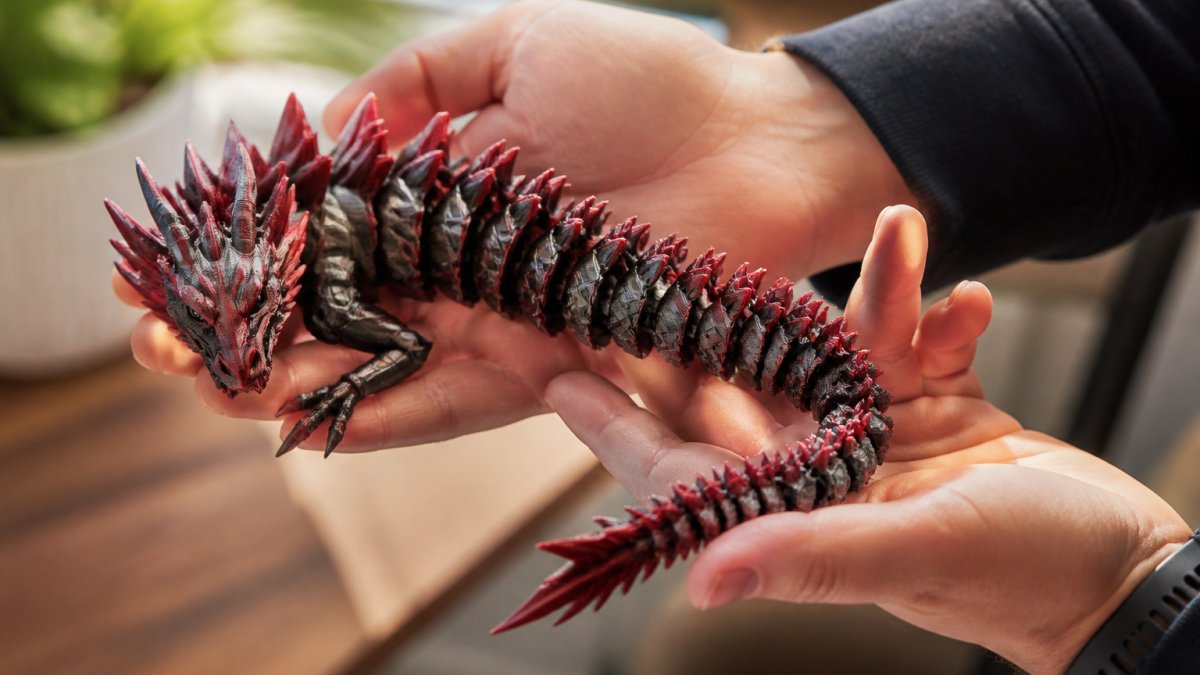
PETG delivers what most users actually need: decent strength, good flexibility, and reliability. It's stronger than PLA, more forgiving than polypropylene, and easier to print than nylon. For articulated dragons and poseable figures, PETG is the sweet spot between durability and printability.
PETG prints maintain their integrity through hundreds of articulation cycles. The joints stay tight, the material doesn't develop stress whitening at flex points, and it resists environmental degradation better than PLA.
The limitation is that PETG isn't the strongest option available. If your figure experiences extreme stress or needs to survive aggressive handling, PETG might not be enough. But for most collectors and fidget enthusiasts, a well-designed PETG print outlasts cheaper alternatives by years.
Polypropylene: Impact Resistance for High-Stress Joints
Polypropylene is the material for things that get dropped. It flexes instead of breaking. A polypropylene joint can bend repeatedly without snapping. This makes it ideal for fidget toys and figures designed for constant manipulation.
For buyers who prioritize durability through impact resistance, polypropylene is unmatched. Snaply3D uses polypropylene for fidget designs specifically because the material survives what other materials cannot.
Resin Prints: Precision and Durability for Collectibles
Thermoset resin prints offer the highest precision and the most dramatic visual detail. Resin captures fine features that FDM materials simply cannot match. For collectible sports memorabilia or highly detailed fantasy art, resin is the only choice.
For display pieces that live indoors, resin prints last indefinitely. For items that see sunlight or handling, resin requires more care than thermoplastics.
3D Printing Infill Settings for Strength
Infill percentage and pattern determine how much material fills the interior of your print.
Infill Percentage and Density Optimization
Infill percentage ranges from 0% (hollow) to 100% (solid). For articulated figures, 15-20% infill is usually sufficient. For fidget toys that see extreme stress, 30-40% is better. Solid fills (100%) waste material and add weight without proportional strength gains.
The pattern matters as much as the percentage. Gyroid infill distributes stress more evenly than grid patterns. Honeycomb patterns offer good strength-to-weight ratios.
For durable 3D prints, match infill to the intended use. A display piece needs 10-15%. A fidget toy needs 25-30%. A structural component needs 40-50%. Going beyond that is waste.
Wall Thickness, Shell Count, and Layer Adhesion
Wall thickness, measured in millimeters or line counts, determines how much material surrounds the infill. Thin walls (0.8mm or 2 lines) create prints that feel hollow and break easily. Thick walls (1.6mm or 4 lines) create prints that feel substantial and survive rough handling.
For durable 3D prints, aim for 3-4 wall lines minimum. This creates enough perimeter material to distribute stress without excessive weight. Shell count directly affects layer adhesion. More perimeter passes mean more opportunities for layers to bond properly.
Print Orientation and Stress Concentration Reduction
Orientation determines how stress flows through the print. A joint oriented vertically (along the Z-axis) experiences stress perpendicular to layer lines. This orientation creates maximum strength because layers are less likely to separate under that stress direction.
For durable 3D prints, orient parts so stress flows parallel to layer lines whenever possible. Design joints with generous radii. Avoid thin walls adjacent to high-stress zones.
Design Techniques That Build Lasting Strength
What makes 3D prints durable isn't just material and settings, it's smart design. A poorly designed part fails regardless of material quality.
Slicer Settings for Specific Geometries
Different geometries need different slicer settings. A thin articulated joint needs higher extrusion temperature and slower print speed than a thick structural wall. A complex geometry with fine details needs smaller layer heights. A simple geometry can use larger layer heights and faster speeds.
Post-Processing and Post-Curing for Structural Integrity
Post-processing transforms a raw print into a durable finished product.
Snaply3D's premium 3D prints receive post-processing specifically designed to maximize durability. Articulated figures are annealed to relieve stress at joints. Resin prints are fully cured to develop maximum hardness and UV resistance.
Premium 3D Print Price Guide: What You're Paying For
Premium pricing reflects material cost, manufacturing precision, and durability engineering. Understanding what drives price helps you recognize genuine quality versus inflated costs.
Material cost varies dramatically. Thermoset resin costs 3-5 times more than basic thermoplastics. Carbon fiber reinforced materials cost 2-3 times more than standard filaments. Post-processing adds labor and equipment costs. Precision printing requires slower speeds and tighter tolerances, which increases production time.
What makes 3D prints durable enough to command premium pricing is the combination of material choice, design optimization, and quality control. A cheap print uses basic material, standard settings, and minimal post-processing. A premium print uses engineered materials, customized settings, and thorough post-processing.
At Snaply3D, premium pricing reflects the engineering that goes into each design. Articulated dragons are engineered for hundreds of articulation cycles. Fidget toys are designed for stress distribution that prevents failure. Sports memorabilia replicas are manufactured with precision that captures authentic detail.
When comparing prices, ask what's included. Does the price cover post-processing? What material is used? Has the design been stress-tested? These factors separate genuine premium products from overpriced alternatives.
Why Premium 3D Prints Outlast Mass-Produced Alternatives
Mass production prioritizes speed and cost reduction. Premium manufacturing prioritizes durability and quality. This fundamental difference explains why premium 3D prints outlast cheaper alternatives by years.
Heat Deflection Temperature and Long-Term Environmental Resistance
Heat deflection temperature (HDT) measures how much a material deforms under heat stress.
Premium materials maintain dimensional stability across temperature ranges.
Long-term environmental resistance includes resistance to humidity, light exposure, and chemical degradation. Premium resins include UV stabilizers that prevent yellowing. Premium thermoplastics include additives that resist oxidation.
UV Degradation and Fatigue Resistance Over Time
UV exposure degrades most plastics.
Premium 3D prints include UV stabilizers that extend outdoor viability by years. Snaply3D's collectible pieces are formulated to resist yellowing and maintain color fidelity.
Fatigue resistance determines how many flex cycles a part survives.
This is where fidget toys show the real difference. A cheap fidget toy becomes loose and unreliable within weeks. A premium fidget toy maintains tight joints and smooth action for years. The difference is material fatigue resistance and design engineering.
Premium 3D prints from Snaply3D deliver durability that mass-produced alternatives cannot match. Our articulated dragons are engineered with stress-optimized joints and premium PETG. Our fidget toys use polypropylene selected specifically for impact resistance and fatigue strength. Our collectible sports memorabilia are manufactured with precision resin and full post-curing for maximum detail retention and UV resistance. When you invest in a premium 3D print, you're buying years of reliable performance, not months of diminishing quality. Explore Snaply3D's collection and discover why collectors choose durability that lasts. Subscribe to our emails for updates on new designs and exclusive releases.
Frequently Asked Questions
Is PLA or PETG more durable for everyday use?
PETG wins for durability in high-stress applications like articulated figures and fidget toys. It offers superior impact resistance and ductility compared to PLA. For items you'll handle regularly, especially articulated collectibles, PETG maintains structural integrity. PLA works for display-only pieces but fails quickly under stress.
What factors contribute to the structural integrity of 3D printed toys?
Four factors determine whether a toy breaks or lasts: material composition (thermoplastic vs. thermoset), infill percentage, wall line count, and print orientation. Post-curing and layer adhesion quality matter equally. Premium manufacturers optimize all four.
How long will a high-quality 3D print last?
Premium resin and PETG prints are designed for long-term durability with proper care, depending on handling and environmental exposure. Articulated figures designed with reinforced joints and optimal infill settings are built to last. Quality prints maintain structural integrity through years of use. Heat deflection temperature and UV resistance contribute to longevity; display items indoors last even longer.
Why are my 3D prints so fragile?
Fragility stems from three causes: weak material choice, insufficient infill density, or poor layer adhesion. Premium manufacturers invest in material science, optimize slicer settings for your specific geometry, and validate designs through stress testing.