

Metal Fidgets vs Plastic Fidgets: Which Is Better?
Last Updated: October 23, 2026
Quick Summary
Metal fidgets win on feel, durability, and long-term value, while plastic fidgets win on price and light weight. Match the material to how and where you fidget: choose metal for daily desk use and plastic or 3D printed pieces for quiet spaces, travel, and budget-friendly gifts.
- Metal fidgets resist joint loosening and finish loss, holding crisp motion through years of daily use.
- Plastic fidgets run quieter because the material damps vibration, making them safer for classrooms and libraries.
- Buy the piece with the best joint construction you can afford, not simply the heaviest one.
- A loud metal fidget in a shared quiet space often gets relegated to a drawer within a week.
- Snaply3D inspects every 3D printed fidget for joints, finish, and motion before it ships.
Table of Contents
- Metal Fidgets vs Plastic Fidgets: The Quick Comparison
- Weight, Feel, and Tactile Feedback Fidget Toys Compared
- Durability and Build Quality: Which Material Lasts?
- Noise, Discreet Use, and Shared Spaces
- Best Fidget Toys for Focus: Matching Material to Your Day
- 3D Printed Desk Accessories That Upgrade Your Setup
- Price, Value, and Picking the Right Fidget for You
- Conclusion
- Frequently Asked Questions
Metal Fidgets vs Plastic Fidgets: The Quick Comparison
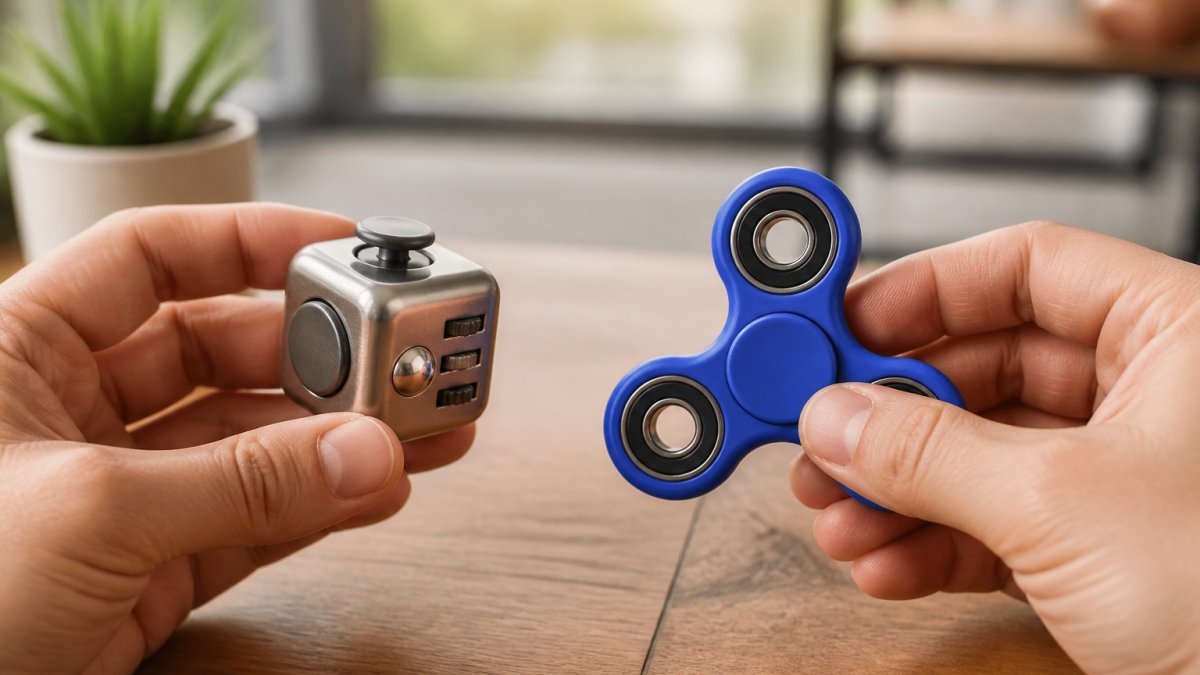
Metal fidgets win on feel, durability, and long-term value. Plastic fidgets win on price and light weight. That is the short answer, and this guide from Snaply3D breaks down exactly where each material earns its place on your desk.
Here is the part most buyers get wrong: the choice is not about which material is "better." It is about matching the material to how you actually fidget, where you fidget, and how long you expect the toy to last.
| Factor | Metal Fidgets | Plastic Fidgets |
|---|---|---|
| Feel | Cool, dense, premium | Light, warm, basic |
| Durability | Years of daily use | Months before wear shows |
| Noise | Audible clicks and clacks | Quieter, softer sound |
| Weight | Noticeable in hand | Barely there |
| Price | Higher upfront | Lowest entry cost |
| Best for | Desk, home, collectors | Classrooms, travel, budget |
Weight, Feel, and Tactile Feedback Fidget Toys Compared
Tactile feedback fidget toys live or die on how they feel in the hand, and this is where metal pulls ahead. A metal fidget has real mass. You feel the weight shift as you flip it, and that resistance is what makes the motion satisfying.
Plastic fidgets are lighter, which makes them easy to pocket but less rewarding to handle. The feedback is softer, and many people describe the difference as the gap between a real tool and a toy.
Weight also affects ergonomics. Heavier pieces sit steadier on a desk and are harder to knock over. Lighter ones suit kids, travel, and anyone who wants zero bulk in a bag.
Durability and Build Quality: Which Material Lasts?
Durability is where the metal-versus-plastic debate gets decided, and the honest answer is more specific than "metal wins." Metal fidgets resist the two failure modes that kill plastic ones: joint loosening and finish loss. A machined metal spinner or slider holds its tolerances because the bearing races and pivot pins are cut from the same stock, so the motion stays crisp instead of developing the wobble that shows up in molded plastic pivots after repeated use.
Plastic fidgets fail differently. Molded hinges and snap-fit joints are the first to go, the plastic flexes a few thousand cycles, then the fit loosens and the piece starts to rattle. Surface finishes on plastic also wear faster: printed or painted coatings scuff at the high-contact points (thumb pads, slider tracks, cube faces) long before the body itself breaks.
Here is the part most reviews skip: build quality matters more than the material label. A cheap metal fidget with a sloppy bearing or an unfinished edge will disappoint faster than a well-built plastic one. When you compare, look at four things:
- Joint construction: machined pins and captured bearings outlast molded snap-fits.
- Surface coating: anodized or PVD finishes on metal hold up better than painted plastic.
- Edge finishing: chamfered and deburred edges feel better and resist chipping.
- Assembly consistency: a piece that arrives tight and silent tends to stay that way.
At Snaply3D, every 3D printed fidget is built with a durable articulated design and inspected before it ships, we check the joints, the finish, and the motion so the piece you unbox is the piece that keeps working. That inspection step is what keeps a fidget in your pocket for years instead of weeks, and it is why our Infinity Cube at $5.99 and Transforming Sphere Fidget Toy at $9.99 hold up to daily handling.

Noise, Discreet Use, and Shared Spaces
Noise is the factor most reviews skip, and it is the one that decides where a fidget actually gets used. Metal fidgets click, clack, and ring, a metal slider's detents snap audibly, and a metal spinner's bearing whirs at a pitch that carries in a quiet room. In an open office, a lecture hall, or a meeting, that sound travels further than you think.
Plastic fidgets run quieter because the material damps vibration instead of transmitting it. That makes them the safer pick for classrooms, libraries, shared desks, and any space where a repeated click draws eyes. The practical rule: match the mechanism to the room, not just the material.
Use this guide before you buy:
- Open office or cubicle: a quiet plastic or 3D printed piece with smooth, damped motion.
- Meetings and calls: a silent slider or a soft-motion cube you can work one-handed under the desk.
- Classroom or library: plastic, full stop, metal clicks carry.
- Home office: metal is fine; the satisfying click is part of the appeal.
- Travel and commuting: compact plastic or a small metal piece with a tight, silent mechanism.
If you want the premium feel without the noise, look for a metal design with a smooth, silent mechanism, no detents, no loose bearing, no rattling parts. And if quiet is the priority, a 3D printed piece like our Metallic Rainbow Spiral Fidget at $3.99 delivers a color-shift finish and smooth handling without the clatter of a metal slider.
Infinity Cube – Premium 3D Printed Fidget Toy →

Best Fidget Toys for Focus: Matching Material to Your Day
The best fidget toys for focus are the ones you reach for without thinking. Match the material to your routine:
- Office desk: metal, for weight and a satisfying click
- Classroom or library: plastic, for quiet handling
- Commute and travel: plastic or a compact metal piece
- Collectors and display: metal, for finish and premium feel
- Gifts: either, depending on the recipient
Focus comes from the habit, not the material. A fidget you enjoy handling is a fidget you keep using, and that repetition is what helps you stay on task through a long afternoon.
3D Printed Desk Accessories That Upgrade Your Setup
3D printed desk accessories give you the metal look and premium feel without the metal price, and this is where Snaply3D shines. Our Infinity Cube flips endlessly with a smooth, satisfying motion at $5.99. It is pocket-sized, lightweight, and built with a durable articulated design.
For something with more visual punch, the Color Shift Gear Fidget Cube at $12.99 shifts through blue, pink, purple, and metallic rainbow tones. It doubles as desk decor and a puzzle-style fidget.

Want a quieter, compact option? The Metallic Rainbow Spiral Fidget at $3.99 measures about 1.75 inches across and delivers a color-shift finish that changes with the light. Each piece is printed, inspected, and packaged by our team.
For a more involved fidget, the Transforming Sphere Fidget Toy at $9.99 folds and transforms in your hands, available in single units and multi-packs.
Price, Value, and Picking the Right Fidget for You
Metal fidgets cost more upfront, but they tend to be the better investment for daily use. A metal piece that lasts years often costs less per month than replacing a plastic toy that wears out. Plastic fidgets still win when budget is tight or you need several for a group.
Use this checklist before you buy:
- Where will I use it most, and does noise matter there?
- Do I want weight and premium feel, or light and pocketable?
- How often will I handle it, daily or occasionally?
- Is this for me, a gift, or a group?
- Does the finish and build quality match the price?
Conclusion
Picking between metal and plastic fidgets comes down to where and how you fidget, and getting it right means a toy you actually keep using. Snaply3D builds 3D printed fidgets with durable articulated designs, premium finishes, and pocket-friendly sizes that suit desks, gifts, and everyday carry. Browse our fidget collection and find the piece that fits your day.
Frequently Asked Questions
Do metal fidgets provide better tactile feedback than plastic ones?
Metal fidgets deliver a denser, more deliberate feel because the material has more mass and a cooler surface. That extra weight makes each click, flip, and rotation register clearly in your hand, which many people find more satisfying than the lighter, hollow feel of plastic. Plastic fidgets can still offer good tactile feedback, especially precision-printed designs with smooth articulation, but they tend to feel less substantial. If you want a fidget that feels like a serious desk tool, metal usually wins on feedback.
Are 3D printed plastic fidgets durable enough for daily use?
Yes, when they are printed and finished well. A precision-printed fidget like the Infinity Cube uses a durable articulated design and holds up to regular handling at a desk, in a bag, or in a pocket. The main wear points are the joints, so quality matters more than material alone. Cheaper prints with rough layer lines or loose tolerances wear faster. Look for smooth flipping movement, a clean finish, and a seller who inspects each piece before shipping.
Why are metal fidget toys considered better for focus?
The weight and resistance of metal give your hands something concrete to work against, which can occupy restless energy without pulling your eyes away from the task. Many people find that a heavier fidget keeps attention anchored better than a light plastic one that spins too easily. That said, focus is personal. Some people prefer the quiet, lightweight feel of a plastic fidget. The best fidget toys for focus are the ones you will actually reach for every day.
Are metal fidgets too noisy for an office?
It depends on the mechanism. Metal-on-metal clicks and spins carry further than plastic, so a metal spinner can draw attention in a quiet room. Plastic and 3D printed fidgets are generally quieter, and designs with smooth articulated movement produce almost no sound. If you share a workspace, a plastic or printed fidget is the safer pick for meetings and open-plan desks. Save the louder metal pieces for home or a private office.
What is the price difference between metal and plastic fidgets?
Metal fidgets typically cost more because of material and machining, often running from around $15 to $40 or more for premium pieces. Plastic and 3D printed fidgets are usually far cheaper. Snaply3D's printed options start at $3.99 for the Metallic Rainbow Spiral Fidget, $5.99 for the Infinity Cube, $9.99 for the Transforming Sphere, and $12.99 for the Color Shift Gear Fidget Cube. For most desk users, a printed fidget delivers the tactile payoff at a fraction of the cost.
