

Artisan 3D Printed Sports Memorabilia Reviews: 2026 Guide
Table of Contents
- Artisan 3D Printed Sports Memorabilia Reviews: What Buyers Should Look For
- Why Artisan Beats Mass-Produced Replicas
- How to Judge 3D-Printed Collectible Quality Before You Buy
- Sports Memorabilia Authenticity: Licensing, Disclaimers, and Seller Proof
- Unique Gifts for Sports Fans: Matching the Piece to the Person
- What Real Reviews Reveal: Ratings, Photos, and Durability Over Time
- Common Mistakes to Avoid When Buying 3D Printed Sports Memorabilia
- Conclusion: Buy With Confidence, Not Guesswork
- Frequently Asked Questions
Last Updated: October 12, 2026
Artisan 3D Printed Sports Memorabilia Reviews: What Buyers Should Look For
Artisan 3D printed sports memorabilia reviews matter because they separate a piece you'll display for years from one that snaps in a week. At Snaply3D, we've watched the collectibles market shift fast: buyers no longer want a cheap plastic trinket, they want a precision-crafted display piece with real detail. This guide breaks down exactly how to judge artisan 3D printed sports memorabilia before you spend a dollar.
The difference comes down to a few things most shoppers never check: print quality, materials, finish, and how the seller handles authenticity. Get those right and you get a keepsake worth showing off. Get them wrong and you get a wobbly, brittle disappointment.
Below, we'll show you exactly how to spot the good stuff, what real reviews actually reveal, and the mistakes that cost buyers money. This is a buyer's guide built to help you buy with confidence, not guesswork.
Why Artisan Beats Mass-Produced Replicas
Mass-produced replicas are stamped out by the thousands, and it shows. Artisan 3D-printed memorabilia is printed piece by piece, which means sharper detail, tighter tolerances, and a finish that actually looks premium on a shelf.
Here's the honest pitch: when you buy artisan, you're paying for attention. A maker who prints individually can inspect each item, catch flaws, and adjust. A factory churning out volume can't. That's why our FIFA World Cup Trophy Keychain gets inspected before it ships, and why the metallic-style finish reads as a real collectible instead of a toy.

- Detail: Crisp edges and recognizable shapes, not blobby approximations
- Finish: Smooth surfaces with a premium look
- Durability: Lightweight yet built to survive handling
- Uniqueness: Small variations make each piece one of a kind
How to Judge 3D-Printed Collectible Quality Before You Buy
Judging 3D-printed collectible quality before you buy comes down to three checks: materials, print method, and finishing. Ask about all three, and you'll know more than most shoppers ever do.
Start with materials. Premium PLA+ holds detail well and keeps weight low, which is why it's the standard for display collectibles. Next, look at the print method. Finally, check the finish. A smooth, even surface signals care; rough patches and stray strings signal a rush job.
Materials, Printing Methods, and Finishing Explained
PLA+ is a premium filament that produces sharp detail and a smooth finish, ideal for keepsakes that sit on a desk or shelf. It's lightweight, which keeps a trophy replica easy to display without a heavy base.
Finishing is where artisans separate themselves. Inspected, sanded, and cleanly finished pieces look premium. Rushed ones show layer lines and rough edges.
A practical tip: ask the seller for close-up photos of an actual finished piece, not a render. Renders hide everything that matters.
Sports Memorabilia Authenticity: Licensing, Disclaimers, and Seller Proof
Sports memorabilia authenticity is the question most buyers forget to ask, and it's the one that protects you. A trustworthy seller tells you exactly what a piece is and where the design came from.
Look for a clear disclaimer and design credit. Our World Cup trophy keychain, for example, is independently manufactured and sold as a fan-made collectible, with the original 3D model credited to its creator under a Creative Commons Attribution license. That transparency is a green flag.
Red flags to watch for:
- No mention of the design source
- Vague claims like "official" with no proof
- No seller identity, return policy, or contact method
Unique Gifts for Sports Fans: Matching the Piece to the Person
Unique gifts for sports fans work best when you match the piece to how the person actually lives, and when you know exactly what you're handing over. A collector wants display quality; a desk worker wants something they can pick up and fidget with; a kid wants something that survives being carried in a backpack. The piece has to fit the person, or it ends up in a drawer.
Here's how to match the piece to the fan, with the specs that actually matter:
- The collector: Prioritize detail, finish, and display presence. Look for multi-color or dual-extrusion builds where color is printed into the piece rather than painted on, so it won't chip. A metallic or color-shift finish reads as a display piece, not a toy.
- The desk worker: Prioritize durability and tactile feel. Articulated designs with movable joints give them something to handle during calls without falling apart. PLA+ keeps the piece lightweight enough to sit on a monitor stand without a heavy base.
- The gift giver: Prioritize a recognizable, crowd-pleasing subject. A trophy replica or a well-known mascot shape lands instantly, even with someone who isn't a hardcore collector.
- The young fan: Prioritize a piece with no small detachable parts and a finish that won't flake. A keychain-sized trophy replica is a daily-use win because it clips to a bag and goes everywhere.
Our Metallic Rainbow Articulated Dinosaur Skeleton covers multiple bases at once: a color-shift finish for display, movable joints for handling, and a look that stands out on any desk. That's the sweet spot for gifting because it works for the collector and the fidgeter in the same household.
FIFA World Cup Trophy Keychain – Premium 3D Printed Collectible →

Personalization: How Custom Orders Actually Work
That proofing step is also your authenticity checkpoint. A seller who shows you the design source and the proof is a seller who stands behind the piece. Pair that with a clear return policy, and you can gift with confidence instead of hoping for the best.
What Real Reviews Reveal: Ratings, Photos, and Durability Over Time
Real reviews reveal what listings can't: how a piece holds up after weeks of handling. Ratings tell you the average experience, but photos and long-term notes tell you the truth. Most 3D printed sports memorabilia reviews stop at star ratings, which is exactly why they're not enough to buy on.
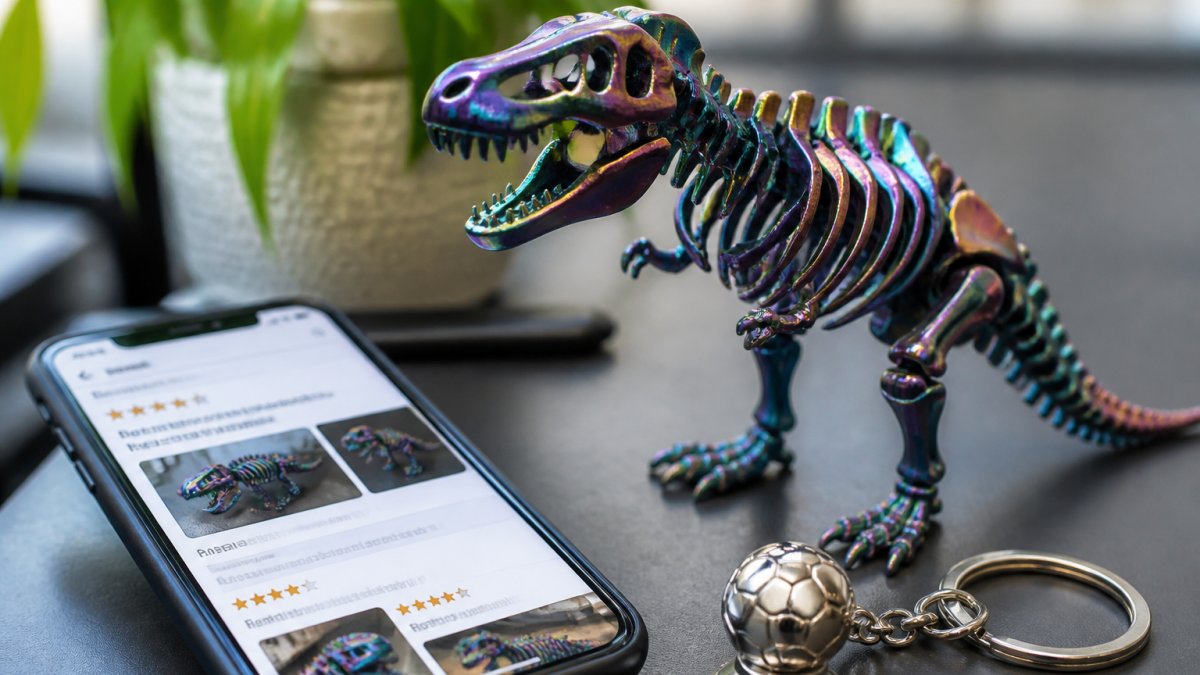
When you read 3D printed sports memorabilia reviews, look for three things. First, customer photos, which show the real finish and color instead of a render. Second, durability comments, especially about joints and handling. Third, seller responses, which reveal how a company treats problems. A single five-star rating means little. A pattern of buyers posting photos and noting that joints stay tight over time means everything.
How to Test Print Quality and Durability Yourself
Star ratings won't tell you whether a piece will survive a year on a shelf. Here's a practical checklist you can run the moment a piece arrives, and the same checks you should look for in reviews before you buy:
- Detail check: Look at the sharpest edges and smallest features. Crisp, recognizable shapes mean the printer was dialed in. Blobby approximations and lost detail mean it wasn't.
- Layer-line check: Run a fingertip along a flat surface. A smooth, even finish signals post-processing care. Visible ridges and stray strings signal a rush job.
- Joint check: If the piece is articulated, move each joint through its full range. It should move freely without wobbling or binding. Tight, smooth joints are the single best durability signal on an articulated piece.
- Wall-thickness check: Squeeze gently. A piece that flexes easily under light pressure has thin walls and will crack under real handling. A piece that holds its shape has enough material where it counts.
- Color check: Scratch a hidden spot with a fingernail. Color that's printed into the piece won't flake. Painted color will. This is the difference between multi-color printing and a cheap paint job.
- Weight check: PLA+ keeps a display piece lightweight without feeling hollow. If it feels like an empty shell, it probably is.
Reading Between the Lines of Seller Reviews
A few patterns are worth more than any single rating:
- Photos over stars. Buyers who post real photos are showing you the actual finish and color. Trust those over renders every time.
- Durability language. Search reviews for the words "joints," "finish," and "arrived." Those three terms surface the durability and shipping truth faster than any star rating.
- Seller responses. A seller who replies to a problem and fixes it is a seller worth buying from. Silence after a complaint is the loudest warning sign there is.
- Repeat buyers. A reviewer who came back for a second piece is telling you the first one held up.
That's the depth most 3D printed sports memorabilia reviews never reach. Use it, and you'll judge a piece on evidence instead of hope.
Common Mistakes to Avoid When Buying 3D Printed Sports Memorabilia
The most common mistake is buying on price alone. A cheaper piece often means thinner walls, weaker joints, and a finish that disappoints on arrival.
Here's what to avoid:
- Ignoring material specs. If a seller won't say what it's made of, walk away.
- Trusting renders over photos. Always ask for real photos of the finished item.
- Skipping the disclaimer. Authenticity and licensing protect your purchase.
- Assuming all sellers handle damage the same. Check the return policy before you buy.
- Overlooking size. A 7.5-inch articulated piece and a pocket keychain serve very different purposes.
Conclusion: Buy With Confidence, Not Guesswork
The gap between a forgettable replica and a keepsake you're proud to display comes down to detail, materials, and honesty from the seller. Judge those three and you'll never overpay for disappointment.
At Snaply3D, we build premium 3D printed collectibles with articulated designs, inspected finishes, and clear design credits so you know exactly what you're getting. Whether you want a detailed trophy replica or an interactive desk piece, we craft each item to be handled, displayed, and enjoyed.
Get started with Snaply3D and bring home a precision-crafted piece that earns its spot on your shelf.
Frequently Asked Questions
What should I look for in artisan 3D printed sports memorabilia?
Check four things: crisp detail on logos and trophy shapes, smooth finish with minimal stringing, tight articulated joints if the piece moves, and a clear product listing that names the material. PLA+ is common for display pieces because it holds detail well. Ask for real customer photos, confirm the return policy, and see whether the seller credits the original 3D model designer, which signals an honest operation.
How can I tell whether a 3D printed sports collectible is well made?
Zoom in on buyer photos rather than the studio shots. Look for even color across the surface, no blobs or gaps where the print started, and joints that hold a pose instead of flopping. A quality piece also feels solid for its size. If the listing mentions inspection before shipping and shows the item in someone's hand, that is a good sign the seller stands behind 3D-printed collectible quality.
Can 3D printed sports figures be personalized?
Snaply3D's catalog focuses on fixed designs like the FIFA World Cup Trophy Keychain and the Metallic Rainbow Articulated Dinosaur Skeleton. Check each listing for specific details.
What should I check before buying a sports collectible online?
Verify the seller's review count and star rating, read the one-star and three-star reviews for patterns, and confirm the shipping timeline and return window. For sports memorabilia authenticity, look for a licensing or disclaimer statement on the product page. A fan-made collectible should say so plainly. Sellers who explain their model credits and manufacturing process are usually the ones worth your money.