

Why Premium 3D Prints Cost More: 2026 Price Guide
Table of Contents
- Why Are Premium 3D Prints Expensive?
- 3D Printing Material Costs: Filament, Resin, and Build Volume
- Post-Processing 3D Prints: The Labor Behind a Smooth Finish
- A Premium 3D Print Price Guide: What Each Dollar Buys
- Failure Rates, Scrap Costs, and the Hidden Cost of Design Iteration
- FDM vs. SLA vs. SLS: How Technology and Print Orientation Change Unit Cost
- Where Premium 3D Prints Are Worth the Price
- Frequently Asked Questions
Last Updated: September 27, 2026
Why Are Premium 3D Prints Expensive?
Premium 3D prints are expensive because the price reflects far more than plastic. It covers industrial-grade materials, machine time, skilled post-processing labor, failed print scrap, and the engineering that keeps articulated joints tight after months of handling. This guide from Snaply3D breaks down every cost driver so you can see exactly what separates a $5 shelf trinket from a collectible built to last.
Here's the short version: cheap prints are priced to sell once. Premium prints are priced to survive. A mass-produced figurine can be molded in seconds once the tooling exists. A bespoke articulated dragon is grown layer by layer, sometimes over many hours, and every one of those layers can fail.
That difference is why premium 3D prints cost more, and why the gap is bigger than most buyers expect. Below, we walk through material costs, post-processing labor, machine depreciation, failure rates, and technology choices, then show you where the extra money actually goes.
3D Printing Material Costs: Filament, Resin, and Build Volume
Material is the most visible cost, and the one buyers underestimate most. Filament and resin prices vary widely by type and grade, and a single large articulated piece can consume far more material than its finished weight suggests. Support structures, purge lines, and failed first layers all get thrown away.
Build volume drives cost in two directions. A larger part needs a larger machine, longer print time, and more material. It also raises the odds that something goes wrong mid-print, which means the whole run is scrapped.
Layer Height, Infill Density, and Material Waste
Layer height is the single biggest lever on print time. Halving layer height roughly doubles the number of passes, which doubles machine time and cost. Infill density works the same way: a solid-core part uses more material and prints slower than a hollow one, but it also feels heavier and more substantial in hand.
Material waste is the hidden line item. Every print generates purge material, brims, and supports that never reach the customer. On complex articulated designs, that waste can be a meaningful share of total filament consumed.
Post-Processing 3D Prints: The Labor Behind a Smooth Finish
Post-processing 3D prints is where most of the human hours live, and it is the cost driver hobbyist guides skip entirely. Support removal, sanding, joint freeing, and inspection are done by hand, one piece at a time. There is no machine that does this reliably for articulated designs.
A common mistake is assuming a print is "done" when the machine stops. It isn't. Removing supports from a detailed dragon without snapping a thin joint takes patience and a steady hand.
Support Structures, Surface Finish, and Precision
Support structures are temporary scaffolding that hold overhangs in place. They are necessary, and they are also the main source of surface defects. Every contact point leaves a mark that has to be cleaned up.
A Premium 3D Print Price Guide: What Each Dollar Buys
A premium 3D print price guide comes down to one idea: you are paying for machine time, human time, and the risk of failure, not just material. Understanding the breakdown helps you judge whether a price is fair.
| Cost Driver | What It Covers | Why It Raises Price |
|---|---|---|
| Material | Filament or resin, supports, purge waste | Higher-grade material and waste both add cost |
| Machine time | Hours the printer is occupied | Longer prints block other jobs |
| Post-processing | Support removal, sanding, joint work | Skilled hand labor, one piece at a time |
| Failure and scrap | Reprints after failed runs | Failed parts are paid for but never sold |
| Depreciation | Wear on the machine over time | Every print brings the printer closer to replacement |
| Energy | Electricity for long print cycles | Long runs draw power continuously |
Machine Depreciation, Maintenance Cycles, and Energy Consumption
Machine depreciation is the cost nobody wants to talk about. Printers wear out. Belts stretch, nozzles clog, and hotends degrade. Every print consumes a slice of the machine's working life, and that slice has to be priced into the part.
Failure Rates, Scrap Costs, and the Hidden Cost of Design Iteration
Failure rates quietly shape the price of every premium print, and most guides never mention them. A print that fails at hour nine wastes the material, the machine time, and the electricity, and it still has to be reprinted from scratch. Those losses get spread across the parts that do succeed, which means the customer buying a finished piece is also paying for the ones that never made it to the shelf.
The Hidden Cost of Design Iteration, The Real Price Driver
Here is the angle almost every competitor misses: the most expensive part of a premium 3D print is not the print at all. It is the design work that happens before a single sellable unit exists.
Why This Is Good News for You
This is the part budget sellers skip, and it is exactly why premium prints are worth it. When you buy a piece that has been through real iteration cycles, you are buying the version that survived all of that testing. The joints hold. The tolerances are dialed in. The design does not snap the first time someone poses it.
FDM vs. SLA vs. SLS: How Technology and Print Orientation Change Unit Cost
Technology choice changes unit cost more than almost any other decision, and it is the first thing a serious shop weighs before quoting a piece. FDM, SLA, and SLS each trade cost against detail, strength, and finish in different ways, and the trade you pick determines whether a premium collectible holds its joints after a hundred poses or loosens up in a week.
Print Orientation: The Cost Lever Most Buyers Never See
Print orientation matters just as much as technology choice, and it is where a skilled operator earns their keep. Rotating a part changes three things at once:
- Support volume. A part laid flat may need almost no supports; the same part stood upright can need a forest of them. More supports means more material, more print time, and more hand cleanup.
- Layer bond strength. FDM parts are weakest along the layer lines. Orienting a joint so the stress runs across layers instead of between them is the difference between a hinge that survives handling and one that snaps.
- Print height and time. Taller orientations mean more layers and longer machine time, which ties up the printer and raises the per-part cost.
Where Premium 3D Prints Are Worth the Price
Frequently Asked Questions
What factors contribute to the high cost of premium 3D prints?
Premium 3D prints cost more because of material quality, post-processing labor, machine depreciation, failure rates, and design iteration. A single articulated figure can require multiple test prints before the joints move smoothly, and each failed print wastes filament, resin, and machine time. Add in support removal, surface finishing, and quality checks, and the true unit cost climbs well above what budget sellers charge for a quick print.
Why is post-processing essential for high-end 3D printed toys?
Post-processing 3D prints is what separates a rough prototype from a display-ready collectible. Support structures leave marks, layer lines show on curved surfaces, and articulated joints need cleaning before they move without binding. Removing supports, smoothing surfaces, and testing every joint takes hands-on time. That labor is a major reason premium articulated dragons and dinosaur skeletons feel different from budget alternatives that skip these steps.
How does material quality affect the price of a 3D printed collectible?
Material quality affects both the price and how long a collectible lasts. Premium silk PLA and color-shift filaments cost more per spool than basic filament, but they hold detail better and give the finish buyers expect. Cheaper filament can print with inconsistent color, weak layer bonding, and joints that snap after a few weeks of handling. Paying for better material is part of why premium 3D prints cost more upfront.
What makes premium 3D prints different from budget alternatives?
Premium prints are printed to order, inspected before shipping, and made with higher-grade filament and tighter machine calibration. Budget sellers often run high infill speeds, skip post-processing, and ship whatever comes off the plate. That difference shows up in surface finish, joint durability, and how well the item matches the product photos. Premium 3D prints trade speed for quality, and the price reflects that trade.
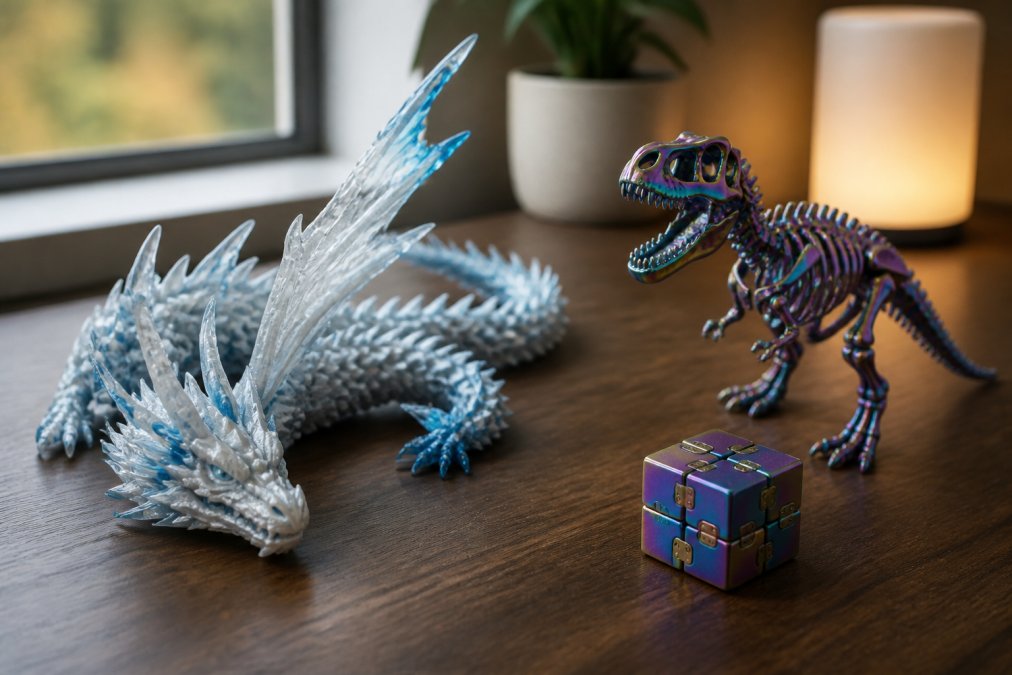
Premium 3D prints cost more because they are built to be handled, displayed, and kept, not thrown away after a week. If you have ever had a cheap printed figure snap at the joint, you already know the difference. Snaply3D prints each collectible to order with premium finishes, articulated designs built to hold up, and a catalog spanning dragons, dinosaur skeletons, fidget cubes, and transforming spheres. Subscribe to our emails and get first access to new drops and offers.