

Rivals3D Alternative for Sports Replicas: 2026 Buyer's Guide
Table of Contents
- Why Sports Fans Are Searching for a Rivals3D Alternative for Sports Replicas
- How to Evaluate 3D-Printed Figures Before You Buy
- What Makes 3D-Printed Sports Collectibles Stand Out
- Unique Gifts for Sports Collectors: Matching the Replica to the Fan
- Replica Accuracy, Materials, and Production Quality Compared
- Pricing, Licensing, and Customization Options
- Conclusion
- Frequently Asked Questions
Last Updated: October 17, 2026
Why Sports Fans Are Searching for a Rivals3D Alternative for Sports Replicas
Sports fandom has always been about more than watching. It is about holding something real. That is exactly why collectors are hunting for a Rivals3D alternative for sports replicas, and why Snaply3D built a catalog around it. The demand is simple: fans want a trophy, a helmet, or a stadium model that looks sharp on a shelf and survives actual handling. Mass-market souvenirs rarely deliver either.
Below, we break down how to judge 3D-printed figures before you spend, which materials hold up, and how to match a replica to the fan on your list. We will also show you where most buyers get burned, because a lot of "replicas" online are photos of one thing and a shipment of another.
Here is the honest truth most guides skip: the difference between a display piece and a dust collector comes down to wall thickness, joint design, and finish work. Get those three right and you have a keepsake. Get them wrong and you have a snapped trophy in three weeks.
How to Evaluate 3D-Printed Figures Before You Buy
Evaluating a 3D-printed figure means checking four things: material, layer finish, joint construction, and the seller's photo honesty. A figure that passes all four will hold up to handling. One that fails any of them usually ends up in a drawer.
Start with the material. PLA is rigid and affordable but brittle under stress. PETG bends before it breaks, which matters for anything with moving parts. Resin prints capture fine detail, like the ridges on a trophy or the stitching on a helmet, but they chip if dropped. Ask which one you are getting before you order.
Then look at the photos. A seller who shows only one angle is hiding something. Zoom in on the joints and the base. Layer lines should be faint and even. A close-up of the actual product, not a render, tells you more than any product description.
- Material listed by name (PLA, PETG, or resin)
- Multiple angles, including joints and base
- Real customer photos, not just studio renders
- Clear return or replacement policy
- Layer lines visible but smooth to the touch
What Makes 3D-Printed Sports Collectibles Stand Out
Detail and durability are what separate 3D-printed sports collectibles from injection-molded souvenirs. A printed replica can carry geometry that mass production cannot: the exact curve of a stadium bowl, the texture of a vintage leather helmet, the raised lettering on a championship trophy. That detail is the whole reason to buy printed in the first place.
Durability is the second differentiator, and it is where cheap sellers lose. Articulated and multi-part builds need proper tolerances at the joints. When a maker gets those tolerances right, the piece moves smoothly and stays tight. When they rush it, you get wobble on day one and a crack by week three.
We build our sports memorabilia line around that principle. That is the standard any collector should demand, from us or anyone else.
Unique Gifts for Sports Collectors: Matching the Replica to the Fan
The best unique gifts for sports collectors match the piece to how the fan actually engages with the sport. A desk worker who fidgets all day wants something tactile. A display collector wants accuracy and a clean finish. A gift that ignores that split usually gets a polite smile and a spot in the closet.
Match the gift to the fan:
| Fan Type | Best Replica Style | Why It Works |
|---|---|---|
| Desk fidgeter | Small articulated or handheld piece | Tactile, easy to pick up between tasks |
| Display collector | Detailed trophy or stadium model | Accuracy and finish matter most |
| Casual fan | Team-themed desk accessory | Looks good without demanding a shelf |
| Serious memorabilia buyer | High-detail, multi-part build | Detail and joint quality justify the spend |
Ask one question before you buy: will this live on a shelf or in someone's hands? That answer narrows the entire catalog in seconds.
Replica Accuracy, Materials, and Production Quality Compared
Accuracy in a sports replica is not a single spec. It is the sum of four production decisions: print resolution, wall thickness, material grade, and post-processing. Most buyers only see the first one in a product photo, which is why so many replicas disappoint in hand.
Print resolution and layer height. Resolution determines how faithfully fine details reproduce, raised lettering on a championship trophy, the ridges on a football helmet, the stitching on a vintage baseball. A finer layer height captures more detail but takes longer to print and costs more. A coarser layer height is faster and cheaper but leaves visible stepping on curved surfaces.
Wall thickness and infill. This is the durability lever most buyers never ask about. Thin walls flex under handling and crack at stress points. Thicker walls resist flex but add weight and print time. For anything that will be picked up, an articulated figure, a handheld trophy, a desk piece, wall thickness matters more than resolution.
Material behavior under stress. PLA is rigid and affordable but brittle; it snaps rather than bends. PETG bends before it breaks, which makes it the better choice for anything with moving parts or repeated handling. Resin captures the finest detail, ideal for display trophies and helmet textures, but chips if dropped and is not the right pick for a fidget piece.
Post-processing and finish. Sanding, smoothing, and finishing visible surfaces is the step rushed sellers skip, and it is usually the difference between a piece that feels premium and one that feels raw. Look for smooth visible surfaces, clean joint lines, and no rough layer ridges on the parts you will touch.
Packaging as a quality signal. A rigid box with padding protects joints and thin details in transit. Bag-only shipping is a red flag for any multi-part or detailed build.
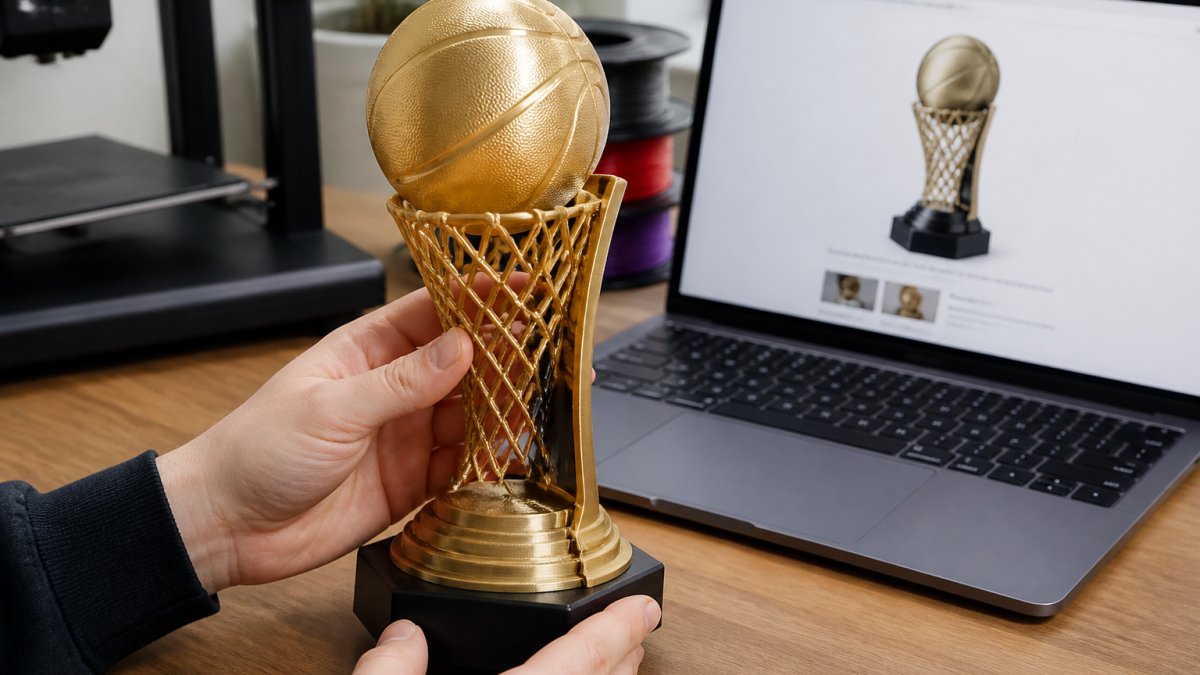
Compare any two options on the same five points:
| Criteria | What to Look For | Red Flag |
|---|---|---|
| Resolution | Fine detail on lettering and texture; close-up photos | Blurry edges, visible gaps between layers |
| Wall thickness | Reinforced joints and base; sturdy in hand | Flexes easily, feels hollow |
| Material | PETG or resin named for handled pieces | Unnamed "plastic" |
| Finish | Sanded, smooth visible surfaces | Rough layer lines everywhere |
| Packaging | Rigid box with padding | Bag-only shipping |
The gap between a good replica and a great one is rarely the printer. It is the finish work and the joint design, and those are the steps rushed sellers skip. When you compare options, weight the factors you can verify, named material, close-up photos, reinforced joints, rigid packaging, over the factors a listing can fake.
Pricing, Licensing, and Customization Options
Pricing for sports replicas is not a single number, and any seller who quotes one flat rate is hiding the variables. The cost of a printed replica is driven by four factors: size, material, detail level, and whether you want customization. Understanding those drivers lets you compare like for like instead of comparing a small PLA desk piece to a large resin display trophy.
What drives cost. Larger pieces use more material and more print time. Resin captures finer detail but costs more per piece than PLA. Multi-part and articulated builds require tighter tolerances and more assembly, which adds labor. Custom work, a nameplate, a scale change, a color scheme, adds design and setup time. Ask the seller what drives the cost on the specific piece you want, then compare that answer across sellers.
Customization is where printed replicas earn their keep. A maker can adjust scale, add a nameplate, or change a color scheme in ways mass production cannot. If you want a one-of-a-kind gift, ask directly whether the seller offers custom work, what the turnaround looks like, and whether they will share a proof before printing. A fixed catalog with no flexibility is a missed opportunity for a personal present.
Licensing: the question most buyers skip. Officially licensed team merchandise carries rights and costs that generic replicas do not. If a seller implies official team affiliation, ask for proof. If they cannot show it, treat the piece as a stylized tribute, not licensed merchandise, and set your expectations accordingly. This matters for display: a licensed piece can be shown publicly with confidence, while an unlicensed tribute is best kept as a personal collectible.
Verification and consumer trust. Before you pay, check three things: whether the seller shows real customer photos, whether they have a clear return or replacement policy, and whether they respond to questions about material and production. A seller who dodges a request for a photo of the exact unit shipping to you is telling you how a damage claim will go. Ask for documentation on licensing claims, and read the return policy before checkout, not after.
Delivery and packaging costs. Shipping method and packaging affect both cost and condition on arrival. Rigid packaging with padding protects joints and thin details; bag-only shipping is a red flag. Factor delivery into the total cost so you are comparing delivered pieces, not sticker prices.
Conclusion
The right replica is the one that survives handling and looks sharp doing it. That means checking material, finish, joint quality, and the seller's honesty before you buy, not after. Fans deserve a piece they reach for, not one that sits in a box.
At Snaply3D, we print premium collectibles, from detailed sports memorabilia to articulated figures and fidget-friendly desk pieces. Our international shipping options mean you can order from wherever you are.
Ready to find the piece that fits your shelf or your hands? Browse the Snaply3D collection and subscribe to our emails for new drops and collector updates.
Frequently Asked Questions
What should I look for in a 3D-printed sports replica?
Check layer lines, joint strength, and material finish. A quality replica has smooth surfaces, tight tolerances at moving parts, and no loose strings or blobs. Ask whether the seller uses PLA, PETG, or resin, since each behaves differently under handling. For display pieces, resin gives finer detail; for fidget or handled items, PETG holds up better. Also confirm the replica is printed at the correct scale and that colors are applied evenly, not just painted over rough surfaces.
How can I compare the detail and finish of sports collectibles?
Request close-up photos from multiple angles, including the base, edges, and any text or logos. Look for consistent layer height, sharp corners, and clean support removal marks. A premium 3D-printed sports collectible should show minimal visible layer lines and a uniform finish. If buying online, check customer photos rather than studio shots. Compare the same item across sellers side by side, and note whether the seller discloses printer type, material, and post-processing steps.
Are 3D-printed sports replicas good gifts for collectors?
Yes, especially when you match the replica to the collector's team or sport. 3D-printed sports collectibles offer detail and customization that mass-produced items often lack. For unique gifts for sports collectors, consider a scaled trophy, a stadium model, or a personalized nameplate. Confirm the seller's return policy and production timeline, since custom pieces may take longer. A well-finished replica displayed on a shelf or desk makes a memorable gift that feels personal.
Can 3D-printed sports figures be customized?
Many sellers offer customization such as team colors, names, numbers, or base engraving. Ask what is included versus extra, and request a proof or mockup before production. Customization affects lead time and may limit returns, so confirm those terms upfront. For a Rivals3D alternative for sports replicas, look for a seller that clearly lists customization options and shows examples of past custom work, so you know the final piece will match your expectations.